The End of Oak Street Review
The best joke in The End of Oak Street is that it spends fifteen minutes convincing you it’s a warm 1980s family picture before it starts eating the neighbours. David Robert Mitchell has made a film that looks like an Amblin adventure and behaves like a creature feature with a mean streak. That bait-and-switch is the point.
This is an $80 million studio swing from the director of It Follows, produced by J.J. Abrams, and stranger than a Warner Bros. late-summer release had to be. Anne Hathaway and Ewan McGregor play a couple whose marriage is already collapsing when the sky intervenes. Whether domestic drama and prehistoric carnage hold together is the central question of any The End of Oak Street review — and the answer is a qualified, enthusiastic yes.
The Story, Without Major Spoilers
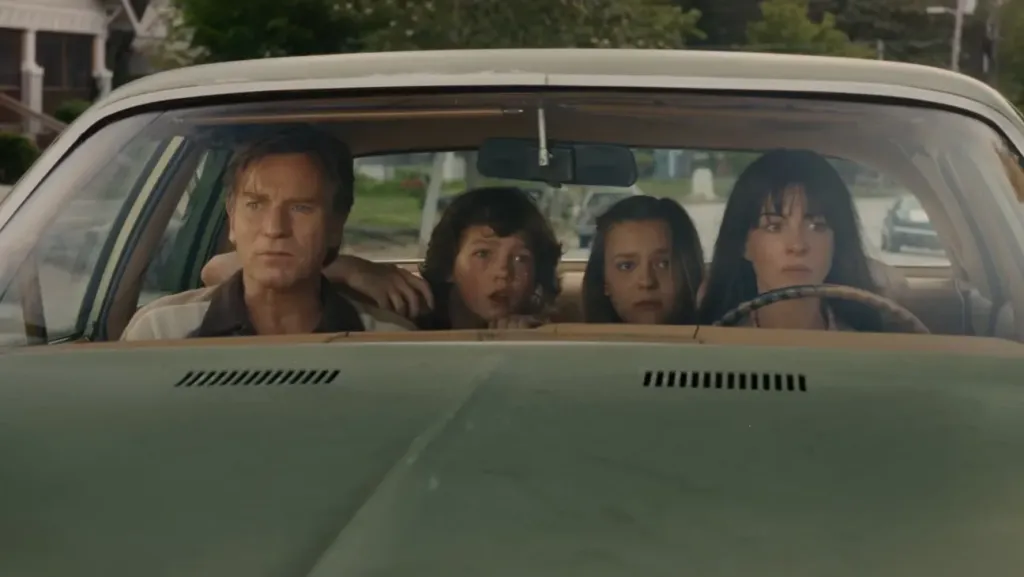
It’s 1982. The Platts — Denise (Hathaway), Greg (McGregor) and teenagers Audrey (Maisy Stella) and Brian (Christian Convery) — live on a picture-perfect suburban street. The cracks show early: Greg is absent in every sense that matters, Denise is unseen and quietly writing a novel about a woman who escapes her life, and the kids have secrets of their own.
Then, overnight, a cosmic event tears Oak Street out of suburbia and drops it somewhere that predates all of it. What follows is not a story of wonder. It’s a survival film, and it moves fast.
Story and Screenplay
Mitchell’s screenplay is sharpest in its first twenty minutes, where the dysfunction is sketched with real economy — a marriage failing in the specific, unglamorous way marriages fail. Then the film spends its remaining 99 minutes running.
The structure is a chain of escalating confrontations and escapes: efficient rather than deep. The film explains almost nothing about the cosmic event, leaving the sci-fi framework as scaffolding rather than substance. Viewers wanting mechanics explained will leave unsatisfied.
The bigger cost is the family drama. Mitchell sets up four characters with genuine interior lives, then parks three while the plot accelerates. The AV Club noted Hathaway’s performance almost compensates for how flat her screen family reads — a fair diagnosis. The survival material crowds out the domestic material rather than fusing with it.
Tonally, the film careens: sincere one moment, gleefully nasty the next. Some critics found the swing exhilarating, others unstable. Both readings are defensible.
Anne Hathaway’s Performance
Hathaway is unambiguously the best thing here. As Denise she plays two registers at once: the exhausted resentment of a woman forced to start every argument in her marriage, and — once the shooting starts — credible physical competence. Multiple critics singled out the image of Hathaway in denim with a shotgun as the film’s defining shot.
The performance works because she never treats the material as beneath her. The dialogue can be cheesy; she plays it straight, big and emotionally legible, like a great B-movie lead. She carries the survival sequences and the emotional beats almost single-handedly. Not awards work, but the reason the film has a pulse.
Ewan McGregor and Supporting Cast
McGregor has the harder job: Greg’s defining trait is denial, and the character is written to frustrate. He plays it well, and his early chemistry with Hathaway is convincingly weary rather than romantic, which is the point. Once the crisis begins, the script gives him less to do.
Maisy Stella brings real texture to Audrey and gets the best non-dinosaur moment. Christian Convery’s Brian is the weak link, through no fault of the actor — he’s written as a panicked liability, which many viewers found grating. The neighbourhood cast exists mainly to prove nobody is safe: functional, and thin.
The Dinosaurs and Action
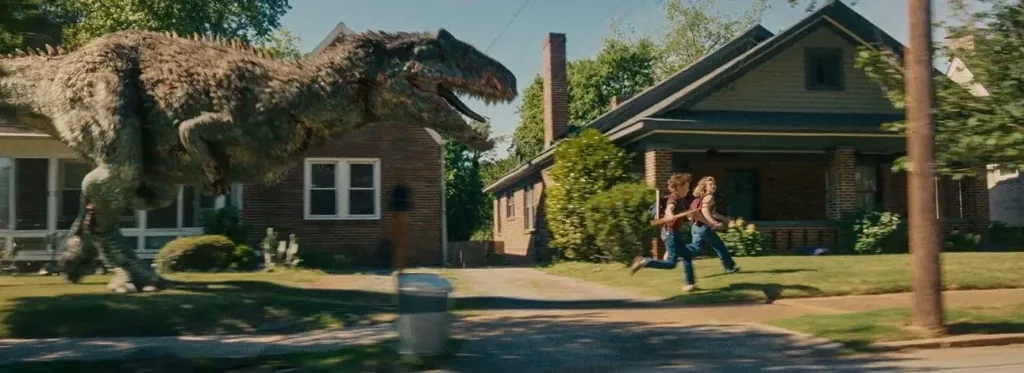
This is where the film earns its ticket. The dinosaurs are not objects of wonder; they are predators, treated with horror-movie logic. Mitchell blocks them the way he blocked the entity in It Follows — half-glimpsed at the frame’s edge, moving in bushes, heard before seen — producing dread rather than spectacle.
The film pushes its PG-13 rating to the edge. Neighbours are torn apart; the streets get grisly. Anyone expecting a family-friendly Jurassic Park riff should recalibrate. The creature work is pleasingly ropy rather than photoreal, but the staging is confident enough that it rarely matters. Several critics called it the most frightening dinosaur film since 1993.
The chases are the highlight, built on geography the audience already understands: cul-de-sacs, garages, back gardens. Suburban space turned lethal beats any set piece money can buy.
Visuals and Cinematography
Michael Gioulakis shoots the 1982 suburb in warm, wide, nostalgic compositions, then keeps the same grammar once the prehistoric world arrives — which is exactly why it unsettles. The street is unchanged; the world around it isn’t. Mitchell’s taste for showy technique occasionally overreaches, but the film has a real visual identity, and Giacchino’s score leans classical-adventure without tipping into pastiche.
The Spielberg Influence
Critics disagree sharply here, and the disagreement is the interesting part.
One camp reads it as an Amblin homage that captures the sweet menace of Gremlins and The Goonies while subverting it: Spielbergian setup, survival-horror payoff. IndieWire called it the summer’s biggest surprise on that basis.
The other finds it late to a nostalgia wave Super 8, Stranger Things and It already exhausted, with Slant calling it a derivative riff with a set-piece problem. There’s truth in both: the 1980s trappings are the least original element, what Mitchell does to them the most.
The Emotional Story
The throughline is a marriage in freefall forced to function under mortal pressure. When the film lets it breathe — briefly — it lands, but it isn’t the priority. RogerEbert.com praised how the carnage is contextualised by ordinary unhappiness; others argued the film cheaps out on the family issues it raises. This assessment sits closer to the second: a strong premise underserved by a script in a hurry.
What Works
- Anne Hathaway, fully committed in B-movie mode
- Dinosaurs staged as horror, not spectacle — tense and frequently frightening
- A lean 99 minutes with almost no dead air
- Gioulakis’s cinematography and the suburbia-as-hunting-ground concept
- Giacchino’s score and an unnerving first act
What Doesn’t Work
- Family drama set up carefully, then abandoned for plot
- The cosmic premise is never meaningfully explored
- Tonal swings from sincerity to gore won’t work for everyone
- Cheesy dialogue in places
- Supporting characters, especially the son, underwritten
Critics vs Audience
Critics landed at 86% on Rotten Tomatoes from 310 reviews and 69 on Metacritic. Audiences were cooler: 77% on the Popcornmeter, a B CinemaScore, roughly 6.6 on IMDb.
That gap is telling. Critics rewarded an original studio swing with real craft; general audiences, arriving for a dinosaur movie, got something nastier than the marketing implied. The box office reflects it: a $21 million domestic opening against an $80 million budget, with a steep second-weekend drop. Well-reviewed, poorly sold.
Final Verdict
Yes — with expectations set correctly. It’s a very good creature feature and a merely adequate family drama, and it never reconciles the two. Mitchell handles a mainstream blockbuster with more control than his indie background would predict, and Hathaway alone justifies the ticket. See it with a crowd if you still can; the scares play far better in a full room. IMAX isn’t essential — this is a film about small spaces, not scale.
Final Rating: 7.5/10
A tense, nasty, wildly enjoyable creature feature with a career-highlight genre turn from Hathaway, held back by a screenplay that abandons its own family drama.